Skip to content

Open String Bow Workouts for Cello, Book Two

by Cassia Harvey

Instrumentation
Cello
Publisher
C. Harvey Publications
More by this composer

Purchase or download

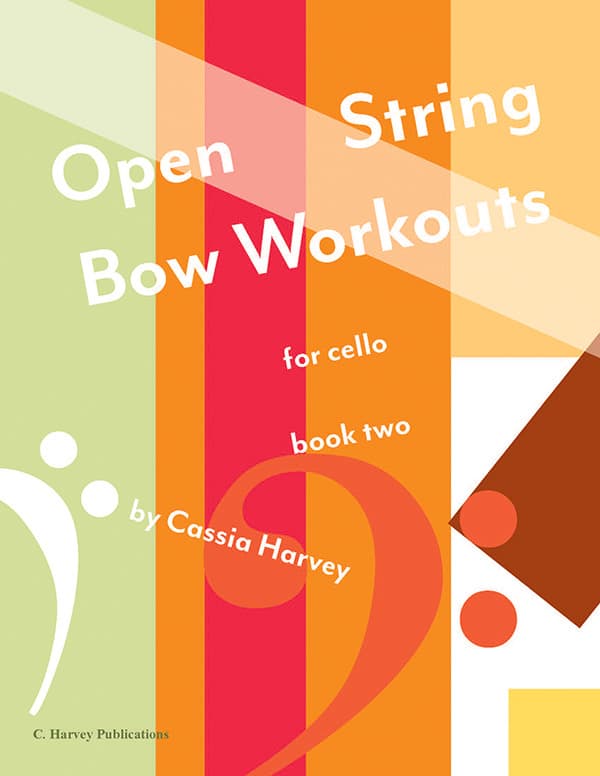
Cover of Open String Bow Workouts for Cello, Book Two
Cover courtesy of C. Harvey Publications

About this piece

This book of exciting bowing workouts for the cello gives you 110 all-new exercises to train your bow on open strings before you begin the rest of your practice. Since there are no left hand notes, you can focus entirely on improving the dexterity and control of the right (bow) hand. This book gives cellists a tremendous resource for developing an all-around bow technique that meets the demands of the cello repertoire, as well as a path to creating better tone. The exercises in this cello bowing book work on on staccato and articulation, dynamics, string crossing, chords, hooked bowing, spiccato, and more. After this book, check out Open String Bow Workouts, Book Three for more studies that will help you bow better!

Technical overview

This cello technique book gives you exercises that will refine your bowing skills, including bow articulation, using only open strings.

Level rubric

Intermediate

Left Hand

  • Fluent in positions 1–4 with confident shifts & reliable intonation.
  • Introduce 5th position via scales/études.
  • Learn tenor clef for higher passages.
  • Early exposure to thumb position basics.
  • Refine combined shifting & extensions.
  • Advance double stops (two‑note chords).
  • Refine vibrato for expressive shaping.

Right Hand

  • High control over multiple bow strokes.
  • Advanced spiccato for fast passages; reliable sautillé.
  • Apply martelé at frog and mid‑bow.
  • Execute rapid string crossings with minimal arm movement.
  • Adjust contact point to modulate tone.
  • Introduce complex bow patterns & chord rolling.

Rhythm & Musicality

  • Faster tempos & varied meter challenges.
  • Tackle compound meters, intricate ornaments & syncopation.
  • Deepen expressive phrasing; analyze piece structure.
  • Clear dynamic contrasts; introduce slight rubato.
  • Enhance ensemble sensitivity.

Levels are approximate guides, not strict requirements.